
COP31 and the Growing Risk of a Fragmented Energy Transition
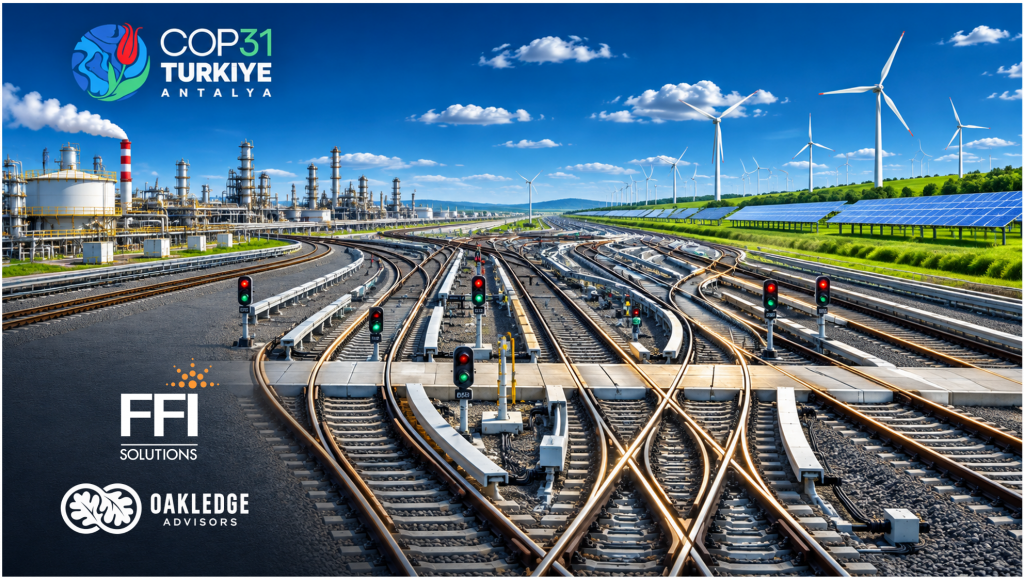
Why divergent climate policies, uneven investment and mounting physical risks may challenge traditional portfolio assumptions.
COP31 concluded in Antalya, Türkiye, on November 22, more than 50 hours beyond its scheduled closing, without an overarching climate agreement. But for institutional investors the more consequential development may be what the outcome reveals about an increasingly fragmented energy transition: not a sudden, coordinated policy shock, but prolonged divergence between national policies and investment pathways. Nearly 200 countries remained divided over fossil fuels, climate finance and the pace of emissions reductions.
The failure to reach an overarching “cover decision” did not undo the Paris Agreement. Countries adopted separate decisions on adaptation and just transition, while nearly 100 countries supported a voluntary initiative to increase electricity’s share of final energy consumption to 35% by 2035. Existing Paris commitments remain in place. Some observers argued that rejecting a text without fossil fuel language preserved the stronger signal from the 2023 Dubai agreement.
Instead of a single policy shock, investors face prolonged policy inconsistency, uneven technology adoption, continued fossil fuel investment and accumulating physical risks. COP31 did not create these conditions, but its outcome makes them harder for investors to ignore. Without a common diplomatic roadmap, these risks are also more difficult to assess and manage across a divided globe.
The outcome does not reverse the economics of renewable energy or electrification. It does, however, underscore the limits of relying on global political commitments as a guide to investment outcomes.
The Network for Greening the Financial System (NGFS) illustrates a related risk in its “Fragmented World” scenario, classified as a “too little, too late” pathway combining divergent policy action with high physical and transition risks. The question for asset owners is whether their climate stress tests adequately capture prolonged fragmentation and, if they do, what actions those scenarios indicate in moments such as these.
From Global Commitments to Fragmented Markets
International climate agreements have helped establish common expectations about the direction of the energy transition. Yet investment decisions increasingly depend on national industrial policies, technology costs, infrastructure constraints and geopolitical competition.
As we explored in ESG’s Blind Spot: China, the Energy Transition, and What Investors Need to See, the forces shaping the transition extend well beyond conventional sustainability frameworks. China’s leading position in many clean energy manufacturing supply chains, for example, reflects economic and strategic decisions that are not dependent on international climate consensus.
Our subsequent analysis, Friend-Shoring and the Energy Transition: What It Costs Investors, examined how governments are redirecting investment through subsidies, trade restrictions and supply-chain policies, often at considerable additional cost.
The outcome in Antalya highlights this emerging reality: the energy transition is unlikely to follow a single global pathway. In fact, given the vastly different developmental starting points of nations around the globe, a single pathway was likely never possible. For investors seeking to navigate these dynamics, geographic policy exposure, supply-chain dependencies and the durability of government incentives may increasingly influence returns.
The same fragmentation applies to fossil fuel supply. Türkiye announced two new oilfield discoveries during the conference, illustrating how production decisions continue despite the absence of a common global roadmap. For investors, divergence reinforces the importance of evaluating reserves by jurisdiction, production costs, asset quality and exposure to alternative demand scenarios rather than relying on a single global transition trajectory.
"For institutional investors, the greater risk is assuming that delayed international agreement means delayed financial consequences."
The Emerging-Market Financing Challenge
The consequences are most tangible in emerging markets, where the cost and availability of capital remain major barriers to transition and adaptation investment.
Countries adopted a climate finance work program, but stronger adaptation funding commitments remained unresolved. UNEP estimates developing countries’ adaptation finance needs at $305 billion annually by 2035, compared with approximately $28–32 billion in international public adaptation finance delivered from developed to developing countries in 2024. These figures describe different years and do not include all domestic or private finance. Without credible risk-sharing mechanisms, otherwise viable projects may struggle to attract capital.
This creates a difficult paradox. Many of the markets with substantial clean energy potential and growing adaptation needs face the greatest financing constraints.
For institutional investors, the issue is not simply whether additional public funding materializes, but whether blended finance, guarantees and other mechanisms can make projects commercially investable. The absence of stronger financing commitments could delay progress, even where underlying investment opportunities remain attractive.
For investors with deep local relationships and market knowledge, this gap may also be an opportunity. Even moderate amounts of capital can deliver meaningful additionality, and potentially attractive returns, for those willing to look beyond their home regions.
The Investment Risk of a Fragmented Transition
The difference between a sudden shock and prolonged divergence matters for how investors define and assess transition risk.
Beyond abrupt repricing after delayed climate action, investors need to consider the cumulative effects of divergent policies and uncertain investment signals.
The Trump administration’s critical minerals strategy illustrates this fragmentation. Government investments, evolving price-support proposals and trade measures are introducing new uncertainties into critical mineral supply chains essential to electrification, even as broader federal climate policies move in a different direction. For investors, such competing signals create opportunities while complicating assumptions about pricing, project economics and long-term policy support.
Such a transition can produce simultaneous but conflicting developments. Electrification accelerates in some markets while fossil fuel demand remains resilient elsewhere.
Physical Risks and Portfolio Interdependencies
Physical climate risks continue to accumulate regardless of diplomatic outcomes.
Our recent post, How Data Centers Reshape Regional Ecosystems and Investment Risks, illustrates how apparently unrelated investments can share vulnerabilities through electricity networks, water resources and infrastructure. A fragmented transition could compound these interconnected risks.
For long-horizon investors, the challenge is not necessarily predicting which transition pathway will prevail but understanding how portfolios perform across several plausible outcomes.
As discussed in The Portfolio Approach Built for an Uncertain Climate, traditional asset-class boundaries and historical assumptions may be poorly suited to risks that cut across sectors, geographies and investment horizons.
A Fiduciary Case That Never Depended on Diplomacy
COP31 may prompt renewed questions about the rationale for climate-aware investing. For public pensions and other fiduciaries under political scrutiny, the response is straightforward: a sound climate risk policy rests on financial materiality, not diplomatic consensus. Physical damage to assets, shifting technology costs and national industrial policy affect returns whether or not nearly 200 governments agree on a communiqué. Policy frameworks set direction, but capital moves on fiduciary logic. Bridging that gap between what governments agree and what investors can act on is where much of the practical work now lies.
As Oakledge’s Max Messervy argued in a recent Net Zero Investor article, navigating politically and legally constrained environments requires rigorous, fiduciary-grounded engagement rather than advocacy or avoidance. In an increasingly fragmented transition, that means equipping investment committees with the analysis, expertise and institutional relationships needed to make defensible long-term decisions.
Beyond the Diplomatic Headlines
COP31’s failure to produce an overarching agreement is a setback for international climate cooperation, but not evidence that the energy transition has stopped. Investment in energy infrastructure, clean technologies and adaptation will continue to respond to economic opportunities, national priorities and changing environmental conditions.
For institutional investors, the greater risk is assuming that delayed international agreement means delayed financial consequences.
The absence of a coordinated roadmap makes it more important, not less, to scrutinize company capital allocation, analyze regional policy, assess physical risk and evaluate portfolios on a forward-looking basis.
This suggests three priorities:
- Incorporating fragmented-transition scenarios into portfolio stress testing
- Evaluating how financing constraints could affect emerging-market investments
- Ensuring that climate risk policies remain grounded in financially material risks rather than assumptions about international policy coordination
COP31 failed to produce a common pathway, but investors still need to prepare for the many different pathways the world may take.

Michael Palmieri
President, FFI Solutions