
ESG’s Blind Spot: China, the Energy Transition, and What Investors Need to See
In his two-part series on sustainable investing, FFI’s Chris Ito established two things. First, that markets may be structurally incapable of validating long-term ESG strategies in real time. Second, that the risks of ignoring the energy transition are not temporary or market-driven – they are baked into the competitive landscape itself.
Both arguments rest on a premise that deserves its own examination: that the frameworks most institutional investors are using to navigate the transition were not built to see the forces actually driving it.
That is not a critique of ESG as a concept. It is an observation about what ESG tools were designed to measure – and where that design leaves significant gaps.
What ESG Was Built to Measure – and What It Wasn’t
ESG scores and ratings were designed to measure corporate behavior against defined criteria: disclosure quality, governance structure, environmental policy, labor practices. These are meaningful inputs, particularly for risk management and for investors with explicit values-based mandates.
But they were not designed to measure a company’s exposure to the physical and industrial forces reshaping the global economy. A company can score well on an ESG rating and still be deeply exposed to transition risk. It can score poorly and sit at the center of the supply chains the transition depends on.
That gap is not a flaw to be corrected with better data. It is a structural limitation of what ESG scores were built to do. Investors who treat ESG ratings as a proxy for transition readiness are answering a different question than the one the transition is actually asking.
Who Actually Built the Transition
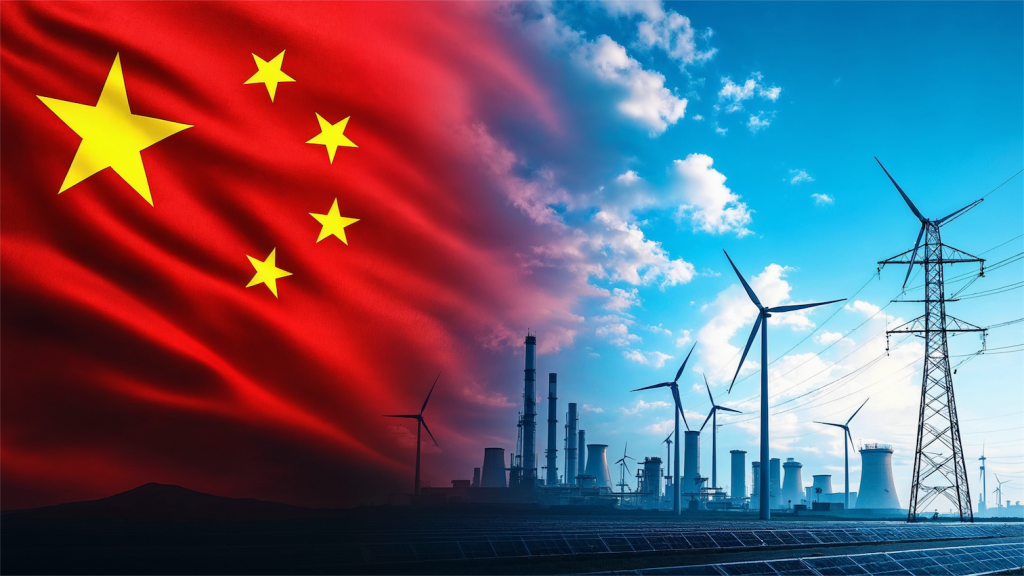
The clearest illustration of that gap is China.
Today, China dominates large portions of the industries underpinning the global energy transition – solar panels, lithium-ion batteries, electric vehicles, grid equipment, and critical mineral processing. This position was not created through ESG ratings or shareholder resolutions. It emerged through decades of industrial policy, infrastructure investment, and strategic state planning – a model that prioritized scale, cost reduction, and supply chain control above nearly everything else.
That reality surfaced with unusual directness at a Heatmap House event during Climate Week NYC in September 2025, which we wrote about here, where Tom Steyer, the billionaire investor and co-founder of Galvanize Climate Solutions, opened by stating that China’s fossil fuel use had already peaked. If accurate, that would represent one of the most consequential and underreported inflection points in the history of the energy transition: the country that built the transition’s industrial foundation may now be turning a corner on its own emissions trajectory.
China’s governance structure, state-driven economic model, and human rights record have long complicated its role within Western ESG frameworks. Many investors still struggle to reconcile those concerns with China’s commanding position across clean technology industries. That discomfort is real. But it does not change the underlying reality: the global energy transition became deeply dependent on Chinese industrial capacity, and most ESG-aligned portfolios were not constructed to reflect that.
This is not an argument that investors should have ignored governance concerns or embraced Chinese equities uncritically. It is an argument that ESG frameworks, as most were applied, systematically underweighted the industrial forces most central to the transition, and that the resulting portfolios may have less actual transition opportunity exposure and more exposure to transition risk than investors assume.
“The transition’s momentum is now somewhat independent of U.S. policy. Which makes China’s structural position not smaller, but more consequential.”
When Policy Tried to Catch Up
The most instructive Western response to China’s industrial advantage was not better ESG disclosure. It was the Inflation Reduction Act. Passed in 2022, the IRA directed hundreds of billions of dollars toward domestic clean energy manufacturing, battery production, and supply chain development – explicitly competing with China on the terms China had set. In the three years after its passage, clean energy investment in the U.S. reached $729 billion, a 92% increase from the prior three-year period. Governments, in short, had concluded what markets had not: that the energy transition was a strategic question, not a sustainability one. The IRA was the clearest proof of that shift.
That acknowledgment now sits in an uncertain place. The IRA’s clean energy provisions have been significantly curtailed under the current administration – most EV and clean energy tax credits ended after 2025. A recent peer-reviewed analysis published in Nature Reviews Clean Technology found that under the One Big Beautiful Bill Act, projected emissions and clean electricity investment shift back toward the baseline as if the IRA had never existed, though aggregate investment in clean electricity is likely to remain near historical highs regardless, given the underlying competitiveness of solar, batteries, and wind. The transition’s momentum, in other words, is now somewhat independent of U.S. policy. Which makes China’s structural position more consequential.
What a More Complete Framework Looks Like
For institutional investors, the practical implication is not to abandon ESG frameworks but to stop asking them to do work they were not designed for. Governance quality, disclosure standards, and stakeholder accountability remain useful risk management tools. The question is what needs to be layered on top.
Three additions matter most.
The first is supply chain visibility. The transition economy is defined by interconnected industrial systems – mineral extraction, processing, component manufacturing, assembly, and grid integration – that span dozens of countries and hundreds of companies. Transition exposure lives throughout those systems, not only at the level of the publicly listed firms with the best sustainability reports.
The second is policy intelligence that extends beyond domestic borders. The regulatory and industrial policy environments in Europe, China, and large parts of Asia are moving in a structurally different direction than the United States. Investors whose policy awareness is anchored primarily in Washington are working with a partial map. The cost curves, capital flows, and competitive dynamics that will shape long-term returns are increasingly being set elsewhere.
The third is avoided emissions as a forward-looking signal. Traditional carbon accounting, Scope 1, 2, and 3, measures what a company produces. In a transition economy, what matters equally is what companies enable others to avoid producing. The clean technology manufacturer, the grid modernization firm, and the efficiency solutions provider: these companies generate economic value precisely by reducing emissions elsewhere in the system. Frameworks that measure only a company’s own footprint miss that contribution – and therefore misread the transition exposure of the portfolios that hold them. See our whitepaper, Understanding Avoided Emissions: A Framework for Investors and Climate Solution Providers for a deeper exploration of this approach and its application.
The Risk of Being Well-Scored and Poorly Positioned
There is an honest difficulty here worth naming directly. The framework described above does not resolve the core problem identified in the first piece of this series: markets may still fail to validate this kind of positioning in the short term. ESG scores will not confirm it. Benchmarks will not reward it immediately. The career risk of acting on long-duration conviction in a market dominated by short-term price setters remains real.
But the alternative is not safety. It is a different kind of risk – slower to accumulate and harder to attribute, but no less consequential. Investors who remain anchored to frameworks designed for a prior era of sustainability may find themselves well-scored and poorly positioned: holding portfolios that look defensible on paper while the structural forces driving the transition reorganize the competitive landscape around them.
The question was never whether to take risk. It was which risk to take – and whether to take it with eyes open.
The transition is not waiting for ESG frameworks to catch up to it. It is being built, contested, and accelerated by industrial strategies, national interests, and cost curves that operate largely outside the vocabulary of conventional sustainable investing.
Investors who understand that – and who build frameworks capable of seeing it – are not making a values argument. They are making a structural one.
The market may not reward that positioning immediately. That is not evidence it is wrong.

Michael Palmieri
President, FFI Solutions