
The Portfolio Approach Built for an Uncertain Climate
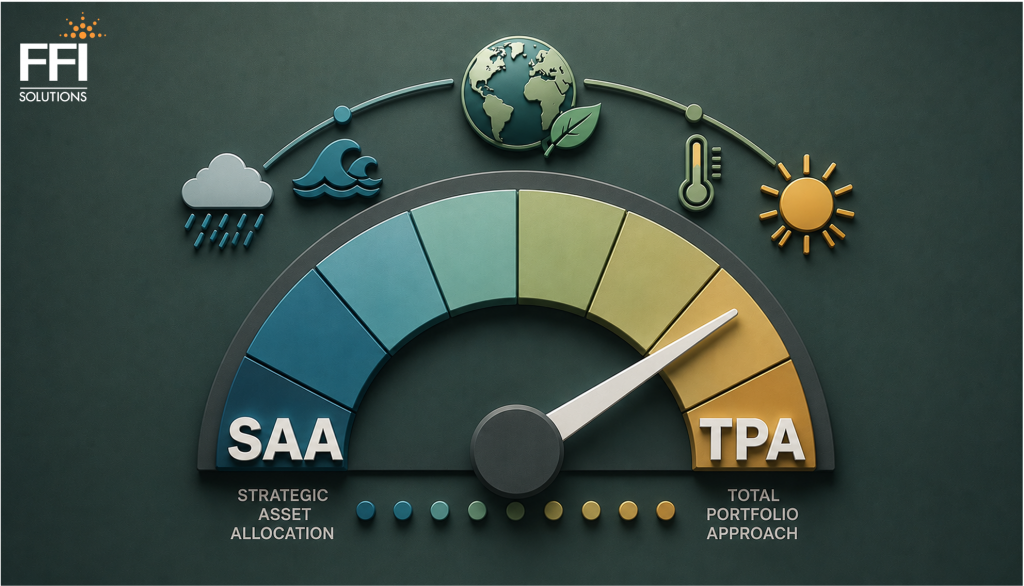
What the rise of the Total Portfolio Approach tells us about climate risk, portfolio thinking, and the limits of historical assumptions.
Today is July 1, 2026. CalPERS goes live with TPA.
For the $650 billion California Public Employees’ Retirement System, the largest public pension fund in the United States, this is the culmination of a multi-year governance transformation: new benchmarks, new accountability structures, new investment mandates, and a new CIO hired specifically to lead the shift. It is the first time a U.S. public pension has formally made this move, and the institutional investment community will be watching closely.
When FFI’s Chris Ito first examined TPA in his January 2025 blog, The Strategic Pivot: Total Portfolio Approach and the Climate Question, he described it as a framework that “certainly seems like it could have been designed with climate risk in mind” and characterized the movement as “growing but quiet.” He ended with a measured question: whether TPA creates enough breathing room for climate integration, and whether that might be enough.
The movement is no longer quiet. The question is no longer hypothetical. And the climate dimension of this story, which was always there, deserves a closer look.
The Landscape Has Shifted
CalPERS’ adoption is the headline, but it isn’t the whole story. The new framework is anchored by a 75/25 reference portfolio of global equities and U.S. Treasuries – a simple but consequential benchmark against which every active investment decision will now be measured. For an institution of CalPERS’ scale, that kind of public accountability is itself a signal worth noting.
CalPERS is not alone, and not first. CPP Investments has been refining TPA since 2006; OPTrust since 2015, delivering sixteen consecutive years of full funding along the way. The Canadian cohort has expanded beyond CPP to include HOOPP, PSP Investments, and OMERS. In Europe, PFZW has moved toward TPA through PGGM. What began as a quiet movement among a handful of sovereign wealth funds has become the defining portfolio debate of the institutional investment world.
Two Kinds of Climate Uncertainty
Our original post argued that SAA’s backward-looking, siloed structure is poorly suited to a risk environment defined by non-linear, cross-cutting dynamics. That argument has only strengthened. It has evolved along two parallel fronts, giving this article’s title its double meaning. Underlying both is a fiduciary question that institutional investors can no longer defer: does a framework built for a stable, historically continuous world still constitute prudent stewardship in one that is neither?
The uncertain investing climate. SAA was built on the assumption that historical data reliably guides future risk, that correlations are stable, and that asset class boundaries are meaningful. Each of those assumptions is under pressure. Geopolitical fragmentation, inflation regime shifts, and liquidity shocks have unsettled long-standing market frameworks in ways that SAA’s infrequent review cycles are poorly positioned to absorb. There is also a governance dimension: under traditional SAA, boards approve strategic allocations while investment teams implement them, leaving neither fully accountable for the portfolio as a whole. TPA’s reference portfolio resolves this cleanly: the board sets risk appetite, the investment team owns the portfolio.
The uncertain physical climate. Here the stakes are highest for long-horizon investors. Stranded assets, carbon pricing shocks, and physical risk cascades don’t appear in historical return series until it’s too late to act. Bob Litterman, founding partner of Kepos Capital and a leading voice on climate risk pricing, is direct in a Man Group podcast: the longer policy action is delayed, the more likely a disruptive transition becomes and the more valuable dynamic portfolio reallocation becomes. CalPERS’ own Investment Beliefs, updated June 15 to reflect the TPA transition, describe climate change as a risk that “emerges slowly over long time periods, but could have a material impact on company or portfolio returns.” That is a precise description of the kind of risk SAA is structurally worst at capturing.
“TPA is a spectrum, not a switch. The most productive question isn’t ‘should we adopt TPA’ but ‘where does our governance, scale, and talent allow us to operate?'”
What TPA Makes Possible for Climate-Aware Investors
Three things TPA enables that SAA structurally resists:
Forward-looking flexibility. SAA optimization relies on historical return data, which means it systematically rejects investments that don’t yet appear in the record, which is precisely the category that many climate-aligned opportunities occupy. TPA allows investment teams to act on forward-looking assessments of risk and opportunity without waiting for historical validation. Early-stage clean energy technologies, adaptation infrastructure, and transition assets in regions not yet pricing physical risk are the kinds of investments most likely to be screened out by backward-looking models and most likely to matter for long-horizon portfolios.
Access to investments that don’t fit traditional asset class buckets. SAA’s predefined allocation bands create structural barriers to novel strategies. TPA removes them. Canadian pension fund OPTrust has used this flexibility to establish dedicated climate incubation portfolios, building conviction in emerging technologies before making larger commitments, and to create governance pathways for emerging strategies that don’t yet fit existing categories. CalPERS’ new Opportunistic and Innovation sleeve, requiring only CIO approval, is the most recent and largest-scale example: its infrastructure program alone deployed $2.6 billion into climate solutions in 2025.
Coherent total portfolio climate integration. SAA tends to silo sustainability considerations into labeled programs disconnected from core investment decision-making. TPA distributes climate risk assessment across the whole portfolio by design. Under CalPERS’ new governance framework, annual sustainability reporting is a mandatory obligation across every asset class – not a separate ESG overlay but a standing feature of the investment architecture.
The Honest Complications
TPA is not a climate strategy. It is a framework. Four limits deserve acknowledgment.
Illiquidity doesn’t disappear. Renewable energy infrastructure relies on decades-long cash-flow assumptions and cannot easily be resized or exited once capital has been committed. The assets most needed for the energy transition are precisely the ones that constrain TPA’s defining advantage.
The divestment question is separate. CalPERS formally prohibits fossil fuel exclusions, managing climate as a risk factor while retaining engagement rights in high-emitting companies. TPA adoption and exclusionary screening are distinct conversations. Investors pursuing both are making two separate arguments.
No portfolio framework substitutes for policy. The intervention that moves private capital at scale is carbon pricing. TPA positions investors to respond when that policy arrives. It does not accelerate its arrival.
The performance debate remains unsettled. Some studies report stronger long-term results among mature TPA organizations, while others argue those comparisons are difficult because institutions differ in governance, liabilities, benchmarks, and risk tolerance. If TPA ultimately proves successful, it may be less because it outperforms during normal markets than because it proves more resilient during periods of structural uncertainty. TPA may be better understood as a governance and risk management framework than a steady source of excess return.
Not One Size, Not One Answer
If TPA “isn’t a climate strategy, it’s a framework,” the same principle applies to adoption itself.
Three recent U.S. examples illustrate the range. CalPERS pursued formal adoption as a full governance transformation. At NYC Bureau of Asset Management, Monte Tarbox declined the TPA label while pursuing the same objectives – reducing silos, improving cross-asset collaboration, enforcing climate policy alignment. “I haven’t drunk the TPA Kool-Aid,” he said recently, while making clear SAA itself needs to evolve. Steven Meier, who led NYC’s pension system from 2022 to 2025, took a third “an evolution, not a revolution” path by reshaping hiring, analytics, and decision-making culture toward total portfolio thinking without a formal declaration.
Jason Malinowski and Tim Atwill, CIOs of two Washington state pension funds, make the case for smaller funds directly: TPA requires governance sophistication, staffing depth, and technology infrastructure that most sub-$10 billion funds don’t have. Their question is the right one: what problem are you trying to solve, and does your institution have the preconditions?
TPA is a spectrum, not a switch. The most productive question is not “should we adopt TPA” but “where does our governance, scale, and talent allow us to operate – and is that where we want to be?”
Maybe That’s No Longer Enough
Our original post ended with a measured question: whether TPA creates enough breathing room for climate integration, and whether that might be enough. Eighteen months on, a more specific answer is possible, though not a simpler one.
TPA doesn’t resolve the uncertain physical climate. That requires policy intervention at a scale no portfolio framework can substitute for. What it does is remove a structural obstacle to engaging with climate risk seriously across a whole portfolio. In doing so, it reframes a question that is ultimately fiduciary in nature. Long-horizon investors have an obligation to beneficiaries who will live with the consequences of the investment climate and the physical climate for decades. Fulfilling that obligation prudently, not just compliantly, requires frameworks capable of seeing the whole portfolio, pricing forward-looking risk, and adapting as conditions change.
Where any given institution sits on the TPA spectrum, and how far along it the institution should move, depends on governance capacity, scale, investment culture, and the specific risks they face. These are not abstract questions. They are the practical work of investment strategy, the kind of assessment that requires both analytical rigor and institutional self-knowledge. The answers will look different for every organization. But the obligation to seek them is the same.

Michael Palmieri
President, FFI Solutions