
Avoided Emissions: Measuring the Real Impact of Climate Solutions
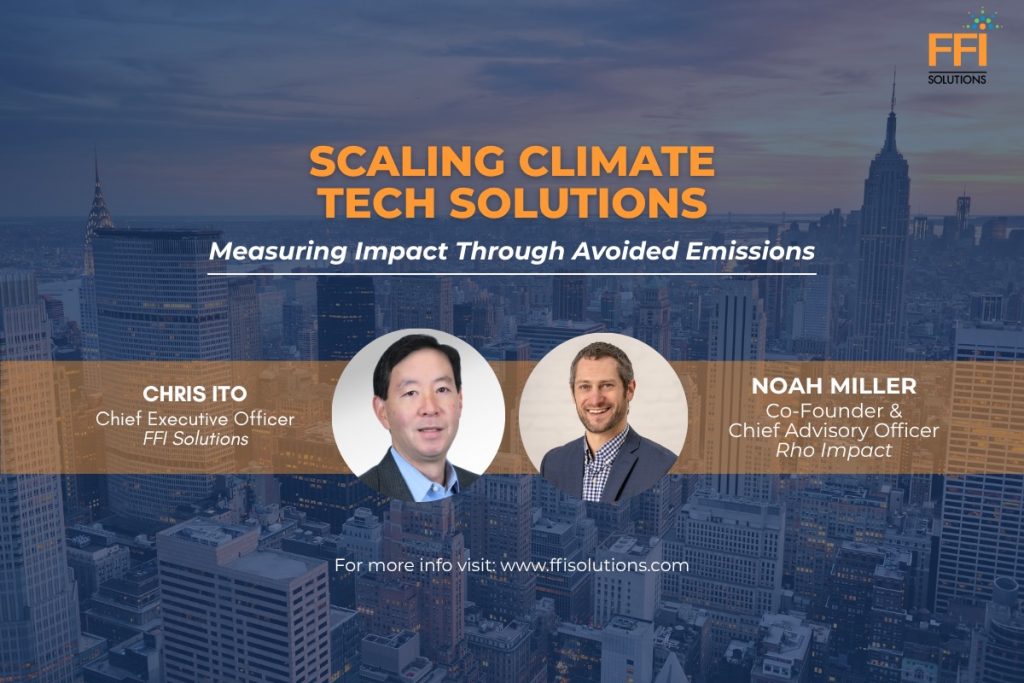
In a September 2025 webinar hosted by FFI Solutions, CEO Chris Ito sat down with Noah Miller, co-founder and Chief Advisory Officer of Rho Impact, to explore one of the most pressing questions in sustainable investing today: how do we accurately measure the decarbonization impact of climate solutions when they scale?
The conversation, conducted as a fireside chat, delved deep into the emerging field of avoided emissions measurement and the evolving landscape of climate solutions assessment. For investors, corporates, and solution providers who are navigating an increasingly complex marketplace, the discussion offered valuable insights into moving beyond traditional carbon accounting toward more forward-looking impact metrics.
Expanding the Definition of Climate Solutions
When asked about his perspective on the climate solutions marketplace, Miller emphasized the need to broaden our understanding beyond obvious technologies like renewables or direct air capture. “When you think of the notion of a climate solution, you think of something that can either avoid, sequester, or mitigate greenhouse gas emissions, or help us to deal with the aftermath and the effects of climate change,” he explained. “But what does that really look like in practice?”
Miller highlighted how Rho Impact focuses on “trying to expand the notion of climate solutions from pure mitigation technologies like DAC (direct air capture) to a broader range of products, services, and other tech solutions that have a legitimate decarbonization impact on their industry application but may not self-identify (or message) they are a climate solution.”
Ito provided a compelling example of this phenomenon in action. A nanotechnology company in Columbus, Ohio, whose founder initially didn’t consider his efficiency-improving technology a climate solution. “I asked him about the decarbonization benefits, and he sort of looked at me a little bit cross-eyed, didn’t know what that meant,” Ito recounted. After connecting with Rho Impact and going through the avoided emissions assessment, the company now prominently features sustainability on its website, demonstrating the untapped potential in technologies that weren’t originally designed with climate in mind.
Listen to the Podcast
Want to know more? Listen to the Beyond Carbon Podcast for the full discussion, real-world case studies, and practical applications of avoided emissions measurement that are shaping the next generation of climate investing.
Scaling Climate Tech Solutions – Measuring Impact Through Avoided Emissions
The Evolution from Carbon Accounting to Avoided Emissions
Central to the discussion was the concept of ‘avoided emissions’ – often referred to as Scope 4 emissions, which measures the greenhouse gases prevented when a solution displaces higher-emission alternatives – and how it represents a fundamental shift in thinking about climate impact. Miller explained this transition: “We’re talking about moving from carbon accounting, retroactive, what happened last year, how do we reduce the bad, or the emissions we were doing, to talking about enhancing the good, or the more of the positive. This climate-positive metric aligns better with other growth-oriented metrics like product sales, revenue per market, and other indicators that connect the solution’s impact potential to the company’s broader market opportunities.”
This represents a crucial evolution for investors who have traditionally relied on Scope 1, 2, and 3 emissions data. As Ito noted from his experience creating investment strategies years ago: “All we were left with, really, was the traditional carbon accounting… for the clean energy companies, we were doing these calculations like the equivalent of cars off the road. But I think what you’re talking about gets to a more granular and better way to account for this.”
The methodology behind avoided emissions measurement involves what Miller described as a counterfactual future approach: “This is the future with business as usual, or with the incumbent technology on the market, and the emission levels projected to be in this scenario. And then you introduce this counterfactual future… where your climate solution is successful and it scales, displacing the incumbent on the market and enabling that avoided emissions impact.”
“We’re moving from reducing the bad — traditional carbon accounting — to enhancing the good. Avoided emissions align with growth metrics like revenue and market share, linking climate impact directly to business success.” — Noah Miller, Rho Impact
Technology at Scale: Rho Impact’s AI-Powered Approach
Rho Impact’s platform, Koi, currently assesses approximately 6,000 products, services, and technologies across diverse sectors – a scale that would be impossible without sophisticated artificial intelligence capabilities. Miller explained how AI has fundamentally transformed their assessment process and made comprehensive impact measurement feasible, at scale, at the push of a button.
From Months to Minutes: Accelerating Impact Assessment
“Things that used to take our science team a month to do, with a lot of hands-on management of clients, getting a lot of insight into what the mechanism on the ground is creating, what kind of primary data are we working with… that used to take a month,” Miller explained. The traditional approach required intensive one-on-one discussions with teams to understand each technology’s impact mechanisms and their associated assumptions about what markets to enter.
Now, through what Miller described as generative AI scripts, the process has been revolutionized: “That process is built into a generative AI script that enables the scraping of the same information that we would get in one-on-one meetings.” This is achieved by the scripts capturing this same critical information from documentation, from public websites, from data that alludes to the impact mechanism and potential incumbents they intend to compete against in the market.
The AI system can analyze and extract critical information about technologies’ environmental benefits, comparing them to incumbent solutions and identifying key impact mechanisms. “Some of these things that our science team used to spend a month to three weeks to get a thorough analysis on. Now we’re able to get a first pass of the same analysis in a matter of minutes using those scripts,” Miller noted.
Maintaining Rigor: The Human-AI Hybrid Model
Importantly, this isn’t a fully automated process. Miller emphasized that the AI-generated analysis “goes through all of the manual science team review and quality assurance. But it’s the same process, same information gathering, but accelerated by an AI script instead of time-consuming meetings with company leadership.” This hybrid approach combines the efficiency of AI with the rigor of human expert validation.
Unprecedented Scale: 6,000 Technologies and Counting
The scale enabled by this AI-powered methodology is impressive. Of the 6,000 technologies assessed, “over 5,000 of those are coming from real companies, with the rest of the thousand being more first-of-kind concepts,” Miller explained. The range spans from obvious climate solutions like renewables, the more mature spaces like solar, wind, and battery storage to unexpected enabling technologies like robots climbing up bridges to get better maintenance data for informing efficiency and structural upgrades, which in turn provides a significant decarbonization impact.
This AI-driven capability allows Rho Impact to identify climate solutions in places others might not look. For example, including companies that wash single-use laboratory equipment for reuse, which Miller noted “has a dramatic impact on customer cost and emission level reduction.” The technology can rapidly assess whether these diverse solutions have genuine climate impact potential and quantify their avoided emissions benefits.
Navigating Political and Regulatory Challenges
Addressing the current U.S. political climate’s hostility toward climate science, Miller offered a nuanced perspective: “Folks that were a little bit on the fence and were swaying with the rhetoric have probably paused in their efforts. But the folks that have always had climate as part of the thesis, I think, have doubled down.”
He emphasized that despite federal rhetoric, state-level regulations in key markets like New York and California remain stringent, and international opportunities continue to drive demand. “The regulations in our key markets in the U.S. (like NY and CA) are keeping this discussion forward. And anybody that’s looking to fundraise outside of the US – like Canada, the EU, in various parts of Asia, Africa… regulations are going into effect and making the concept of impact critical to competing in these markets.”
Connecting Impact to Commercial Value
A crucial theme throughout the discussion was the connection between environmental impact and commercial value. Miller explained that avoided emissions are achieved through concrete mechanisms: “Less energy requirements compared to the incumbent solution, less material requirements compared to the incumbent solution, and so on.”
Using the example of Grenova, a company that washes single-use plastics for re-use in laboratories, Miller illustrated this connection: “If you can reuse single-use plastics and reduce the purchase price by 90%, the money you save, the emissions you avoid… that’s how you commercialize your impact and address dual customer pressures for return-on-investment AND return-on-impact.”
This alignment addresses Ito’s point about ‘broadening the tent’ beyond impact investors: “If I’m sitting there with a purely financial hat on, and I’m making my decisions based on finance, and I can say, oh, I can get the benefit of emissions reductions as well. Well, that’s a win-win, why wouldn’t I do that?”
Market Adoption and Future Outlook
The webinar revealed encouraging trends in market adoption. Miller noted that “something like 25% of the folks submitting [to CDP reporting] were disclosing the avoided emissions impact, or the Scope 4 emissions impact of their products and services.” Similarly, in the EU’s SFDR framework, the highest number of Article 9 funds were reporting on avoided emissions.
Current users of Rho Impact’s Koi platform span the investment ecosystem, from large institutional investors assessing fund strategies to solution providers seeking to quantify and communicate their decarbonization potential. As Miller explained: “Anybody that is investing in, innovating on, or trying to bring these solutions to market needs to have an understanding of and be able to credibly communicate the impact potential of the solutions.”
Ensuring Robustness and Transparency
Addressing concerns about measurement reliability, Miller emphasized Rho Impact’s commitment to transparency: “Everything is traceable and transparent for every data point, every assumption, every omission, and anything else we use to put together a solution model. This ensures any greenwashing risk is mitigated.”
The Koi platform aligns with emerging standards from organizations like CDP, Project Frame, and the World Business Council for Sustainable Development, ensuring methodological consistency and alignment with the most authoritative voices in climate investing.
Looking Forward: The Future of Climate Solutions Measurement
The conversation concluded with reflections on the collaborative nature required to advance the climate solutions ecosystem. As Ito noted: “Solution providers need two things – they need capital to grow their business, and they need customers.” The key is facilitating connections between solution providers, corporate purchasers, and investors.
Miller’s closing message to attendees captured the urgency and opportunity: “If you are working on climate solutions, you should be working in Koi.”
This webinar recording offers valuable insights for anyone involved in climate solution investment, development, or procurement. As the market continues to evolve beyond traditional ESG metrics toward more sophisticated impact measurement, understanding avoided emissions methodology becomes increasingly critical for winning in the low-carbon economy.