
How Data Centers Reshape Regional Ecosystems and Investment Risks
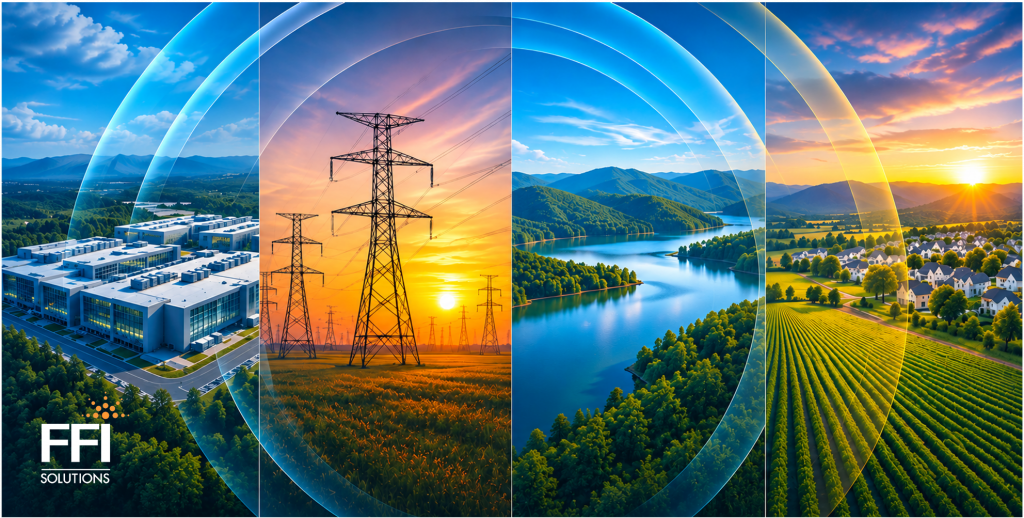
Understanding the implications of shared resources, environmental pressures, and ecosystem resilience for investment portfolios
Data center exposure extends across portfolios, from direct investments to utilities, infrastructure, real estate, technology companies and credit. Electricity tariffs, water-use permits, development moratoria, community opposition and operating curtailment can materially affect facility cash flows and asset values. These direct risks are consequential, but an assessment limited to the facility and its immediate impacts leaves wider portfolio dependencies unexplored. As our post El Niño 2026: The Financial Effects Emerging Across Portfolios showed, holdings that appear diversified by sector or asset class may depend on the same data centers or rely on the same electricity networks, water resources and local infrastructure, creating concentrations of risk that are not immediately apparent. Physical climate events and evolving transition impacts can compound these dependencies, particularly when environmental conditions deteriorate.
The scale and influence data centers have on local environments make them consequential participants in the ecosystems they inhabit. What changes when we consider data centers not simply as infrastructure assets, but as participants in these ecosystems? Their resource requirements and operations influence surrounding communities, nature-based systems, and economic activity. Their presence changes resource availability and environmental conditions, while changes in those same systems affect their operations. For investors, these reciprocal relationships may not only expose risks that conventional asset-level analysis may overlook but also reveal opportunities for investments that strengthen ecological and economic resilience.
How Data Centers Influence Existing Ecosystem Pressures
The significance of data centers extends beyond individual facilities to how their presence may change the conditions supporting other investments, particularly when environmental pressures alter the relationships among ecosystem participants. Data centers participate in three interconnected dimensions of an ecosystem: natural resource availability, ecological functions, and economic and community activity.
Resource relationships. A data center may share a watershed with agricultural producers, manufacturers and other businesses whose financial performance depends on water availability. Its additional demand can compound existing resource constraints, but the outcome also depends on competing consumption, hydrological conditions, water allocations and infrastructure. During prolonged heat and drought, cooling requirements may increase as water availability declines and surrounding natural systems experience additional stress. Other geographic connections may be less apparent. Ceres (2026) documents substantial water requirements for electricity generation that supplies data centers, including in water-stressed areas far from the facilities. These interactions can create dependencies among investments that do not share the same immediate geographic or commercial exposures.
Ecological relationships. A data center enters a landscape where biodiversity, vegetation, soils, habitats and water systems perform essential functions that support surrounding economic activity. Large-scale development can alter these functions through land conversion, habitat fragmentation and changes in natural drainage, potentially increasing vulnerabilities already associated with climate conditions and cumulative development. During extreme rainfall, reduced soil permeability and altered runoff can increase downstream flood exposure, as documented by the U.S. Geological Survey. The investment implications extend beyond the data center’s own physical exposure. Real estate, infrastructure and businesses elsewhere in the watershed may depend on the same natural flood protection and water regulation functions, even without a commercial connection to the facility. The extent to which additional development changes those functions depends on existing ecosystem health, biodiversity and the combined effects of other environmental pressures.
Economic and community relationships. Data centers can alter regional investment conditions through infrastructure requirements, economic activity and public revenues. Virginia’s JLARC (2024) documents substantial economic benefits, primarily from construction, alongside concerns over electricity infrastructure costs. Where data center expansion coincides with electrification, changing generation requirements and existing grid constraints, the financial implications depend on how additional capacity is developed, tariffs are structured and costs are distributed. Economic benefits for some holdings may therefore coexist with greater costs or infrastructure dependencies for others, particularly when environmental events simultaneously affect energy availability and demand.
For investors, these relationships raise a different set of questions: which dependencies across portfolio holdings become more consequential with a data center’s presence, and where might that presence change the need, feasibility or economic value of investments that strengthen ecosystem resilience?
When Impacts Become Financially Significant
The significance of these interdependencies raises a question that conventional assessments of individual facilities cannot fully address: how does the presence of a large, resource-intensive participant change an ecosystem’s capacity to sustain the natural systems, communities and economic activities already dependent on it, and how might those changes affect the financial performance and resilience of other portfolio holdings?
Attribution and financial materiality. Three factors must be distinguished: the ecosystem’s existing trajectory, changes attributable to the data center, and the financial sensitivity of investments dependent on the affected systems. Changes in water availability, biodiversity or environmental conditions cannot automatically be attributed to a data center without considering existing development, resource consumption, climate variability and other pressures. The key investment consideration is whether the data center’s incremental influence sufficiently changes access to shared resources or the protection provided by ecological functions to affect cash flows, asset valuations or credit quality across other holdings.
Changing conditions. A facility’s additional resource requirements may be readily accommodated under normal conditions but become consequential during periods of environmental stress. The question is not simply how individual investments respond to drought, extreme temperatures, infrastructure disruptions or supply curtailment, but whether the data center’s participation changes those outcomes, including the ability of the surrounding ecosystem to recover. For portfolio stress testing, the consequential change may be the threshold at which other holdings begin to incur losses, rather than their exposure under normal conditions. The analytical test therefore goes beyond the size of a data center’s footprint to consider whether its demand during periods of peak stress undermines the power and water assumptions on which other holdings depend. It is the same test we applied to the regional shifts linked to AMOC.
Evaluating resilience measures. An intervention that improves resource efficiency or protects data center operations may do little to alleviate constraints affecting other ecosystem participants. More broadly beneficial measures would need to address underlying vulnerabilities, maintain essential ecological functions and demonstrate improvements extending beyond the facility itself. Their investment significance depends on whether they materially reduce risks to existing holdings or support commercially viable opportunities, how costs and benefits are distributed, and whether improvements persist as environmental conditions change.
“Holdings that appear diversified by sector or asset class may depend on the same data centers or rely on the same electricity networks, water resources and local infrastructure, creating concentrations of risk that are not immediately apparent.”
Case Studies: How the Surrounding Ecosystem Shapes the Outcome
Phoenix and Northern Virginia illustrate how data centers with similar resource requirements can have substantially different effects depending on existing ecosystem conditions, competing demands and the resilience of surrounding economic activities.
Phoenix: When Water Is the Constraint
According to the City of Phoenix (2026), Phoenix draws approximately 40% of its drinking water from the Colorado River, where reduced allocations are adding pressure to an already stressed regional water system. The city has substantial water reserves and established management capabilities, but data center expansion introduces additional demands within a broader ecosystem facing extreme heat, drought and competing agricultural, industrial and ecological requirements. For investors, the distinction lies in how individual facilities source water and electricity and whether their presence changes resource constraints affecting other holdings.
Northern Virginia: When Concentrated Development Stresses the Potomac Watershed
In the Potomac basin, concentrated data center development creates different pressures. A March 2026 study found that data centers accounted for approximately 1% of Washington metropolitan area water withdrawals but up to 12% of consumptive use during summer. This seasonal concentration, occurring when river flows are typically lowest, raises questions about shared water reliability, downstream ecological functions and potential exposure across other investments dependent on the watershed. For investors, this underscores the importance of assessing seasonal consumptive use alongside annual withdrawals, which on their own can obscure pressure during periods of low river flow.
The comparison illustrates why data center exposure must be evaluated against the existing capacity and vulnerabilities of each ecosystem, rather than through uniform assumptions about facility resource consumption.
From Resource Demands to Resilience Investment Opportunities
A data center’s influence on an ecosystem is not limited to the resources it consumes or the pressures it creates. Its presence may also reveal where existing systems require greater resilience, or where resources previously considered waste could become economically valuable. For institutional portfolios, these circumstances introduce considerations extending beyond the data center itself to the financial prospects of other investments dependent on the same ecosystem.
In Virginia, Loudoun Water developed a reclaimed-water network initially serving data center cooling requirements, delivering more than 750 million gallons to customers in 2025 and offsetting potable-water demand. This illustrates how infrastructure developed in response to data center requirements can serve broader resource needs. However, the net effect on watershed resilience also depends on consumptive losses, downstream flows and competing demands – all considerations relevant to other water-dependent holdings.
Resource recovery offers a different possibility. In Finland, Fortum and Microsoft are developing a system to recover data center waste heat for district heating, potentially supplying approximately 40% of regional demand once fully implemented. Although integration remains prospective, the arrangement illustrates how an otherwise unused output could become a commercially valuable input to another economic activity, with implications for energy costs, infrastructure investment and operating resilience.
Biodiversity and ecosystem functions are equally important. Where data center development adds pressure to natural drainage, water regulation or habitat connectivity, maintaining those functions may be relevant to the resilience of surrounding real estate, agriculture and infrastructure holdings. The potential financial value lies in the extent to which improvements protect productive capacity, reduce physical vulnerabilities or sustain economic activity, rather than in environmental restoration alone.
Translating Impacts into Investment Strategy
Data centers cannot be evaluated independently of the ecosystems in which they operate. Their scale, resource requirements and influence on surrounding natural and economic systems make them consequential participants, capable of magnifying existing vulnerabilities while remaining dependent on the health and resilience of those same systems.
For investors, this perspective reveals more than additional sources of risk. It offers a way to recognize dependencies among seemingly unrelated holdings, identify where environmental and economic pressures may converge, and evaluate where resilience measures could address shared vulnerabilities while creating broader economic opportunities. The opportunity is not simply to reduce a data center’s resource consumption, but to recognize where its presence warrants investment measures that strengthen the ecosystems supporting biodiversity, communities and economic activity.
At FFI and Oakledge, we bring together physical and transition climate risk intelligence, ecosystem dependencies and portfolio exposure analysis to identify data center risks that may not be apparent through conventional assessments. Our work examines how these interconnected systems influence investments, identifies potential concentrations of vulnerability, and evaluates practical resilience measures and their economic implications. That analysis can help investors determine where to reassess inputs to valuation, credit and liquidity analyses, as well as approaches to manager oversight or portfolio positioning.

Lynn Connolly
Head of Climate Risk Solutions